• Skip to primary navigation
  • Skip to main content
  • Skip to primary sidebar
  • Skip to footer

NetFamilyNews.org

Kid tech intel for everybody

Show Search
Hide Search
  • Home
  • Youth
  • Parenting
  • Literacy
  • Safety
  • Policy
  • Research
  • About NetFamilyNews.org
    • Supporters
    • Anne Collier’s Bio
    • Copyright
    • Privacy

In the face of school violence, what do we default to?

April 10, 2014 By Anne Leave a Comment

Certainly what all the coverage of the Murrysville, Pennsylvania, school stabbings indicates is a society trying to make sense of a so far inexplicable tragedy, but there is no – zero – sense or accuracy in the Pittsburgh Post-Gazette’s “report” that this is “the latest face of the national epidemic of school violence.” There is no such epidemic. In fact, the latest national data available shows a steep decline in school violence for a long time.
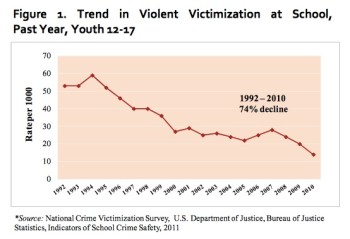
CCRC chart
From CCRC report

“Between 1992 and 2010 for youth 12-18, school-related violent victimizations declined 74%,” according to a report from the University of New Hampshire’s Crimes Against Children Research Center (CCRC), citing the US Department of Justice’s National Crime Victimization Survey. “The declines were fairly linear during this period, and included a drop of 50% in school-related violence … from 2007 to 2010.”

The same report said bullying – which some news stories speculated was behind 16-year-old Alex Hribal’s attacks – is down too. “Four US national data sets show substantial declines in face-to-face bullying and peer-related victimizations at school from the 1990s to recent years. Some of these are quite large.” As for cyberbullying, the CCRC reported that an increase it cites “is probably best seen simply as growth in the usage of electronic media for all kinds of socialization including its negative forms.”

Selfie of a student hero (& victim)

We don’t think enough about what characterizations like a “national epidemic of school violence” say about our young people. Maybe zooming in on the story of one of the victims better illustrates how unfair it is to rush to negative conclusions – the story of a selfie posted online from the hospital. It was posted on Instagram by Nate Scimio, the student credited with having pulled the fire alarm, “reportedly an action that eventually saved countless other students,” according to a commentary at CNN.com.

“His selfie happened standing in a hospital gown, with loose, Justin Bieberesque hair looking more like he suffered from a soccer injury, not from being the victim of a mass stabbing attack,” wrote commentator Mel Robbins. But sadly “the result of his lighthearted photo has been a trashing and analyzing from observers online about whether that selfie was ‘appropriate.'”

Default to respect!

What’s the deal, people? We need to support our young people! I’m right with Robbins in questioning this seeming reflex on some adults’ part to leap to negative conclusions about young people’s use of digital media. We need to default to respect for kids and open-mindedness toward their media use. Sharing a selfie with peers on Instagram was probably part of Nate’s healing from the trauma he experienced. As Robbins writes, “when he wrote ‘Chillin’ At Children’s’ to his then approximately 200 followers on Instagram, he was letting his friends know that he was OK.”

What better example of how important it is to get on with turning around this tendency to believe the worst about kids and technology. They deserve better!

Related links

  • National Crime Victimization Survey 2013
  • The New York Times’s coverage
  • “Neutralize the negativity bias against kids’ Net use”
  • “Reflexive responses to digital bullying & self-harm not helpful”
  • About the last national school violence story: “We are all first responders, in a way”
  • “About the worldwide selfie phenomenon”
Share Button

Filed Under: bullying, cyberbullying, Literacy & Citizenship, mobile, Risk & Safety, School & Tech, Social Media, Youth Tagged With: attack, Crimes Against Children Research Center, data, Forbes Regional Hospital, Franklin Regional High School, Murrysville, Nate Scimio, Pittsburgh, school violence, stabbing

Reader Interactions

Leave a Reply Cancel reply

Your email address will not be published. Required fields are marked *

This site uses Akismet to reduce spam. Learn how your comment data is processed.

Primary Sidebar

NFN in your in-box:

Anne Collier


Bio and my...
2016 TEDx Talk on
the heart of digital citizenship

Connect with me on LinkedIn
See me on YouTube way back in 2011!

IMPORTANT RESOURCES

Our (DIGITAL) PARENTING BASICS: Safety + Social
NAMLE, the National Association for Media Literacy Education
CASEL.org & the 5 core social-emotional competencies of SEL
Center for Democracy & Technology
Center for Innovative Public Health Research
Childnet International
Committee for Children
Congressional Internet Caucus Academy
ConnectSafely.org
Control Shift: a pivotal book for Internet safety
Crimes Against Children Research Center
Crisis Textline
Cyber Civil Rights Initiative's Revenge Porn Crisis Line
Cyberwise.org
danah boyd's blog and book about networked youth
Disconnected, Carrie James's book on digital ethics
FOSI.org's Good Digital Parenting
The research of Global Kids Online
The Good Project at Harvard's School of Education
If you watch nothing else: "Parenting in a Digital Age" TED Talk by Prof. Sonia Livingstone
The International Bullying Prevention Association
Let Grow Foundation
Making Caring Common
Raising Digital Natives, author Devorah Heitner's site
Renee Hobbs at the Media Education Lab
MediaSmarts.ca
The New Media Literacies
Report of the Aspen Task Force on Learning & the Internet and our guide to Creating Trusted Learning Environments
The Ruler Approach to social-emotional learning (Yale Center for Emotional Intelligence)
Sources of Strength
"Young & Online: Perspectives on life in a digital age" from young people in 26 countries (via UNICEF)
"Youth Safety on a Living Internet": 2010 report of the Online Safety & Technology Working Group (and my post about it)

Categories

Recent Posts

  • Safety by co-design: How we can take youth online safety to the next level
  • Much-less-social media on Facebook’s 20th birthday
  • What child online safety really needs, senators
  • Welcome to 2024!
  • Supporting the youngest witnesses of this humanitarian crisis
  • Should our kids learn how to use generative AI? Well…
  • The missing piece in US child online safety law
  • Generative AI: July 2023 freeze frame

Footer

Welcome to NetFamilyNews!

Founded as a nonprofit public service in 1999, NetFamilyNews quickly became the “community newspaper” of a vital interest community of subscribers in more than 50 countries. Site and newsletter became a blog in the early 2000s. Nowadays, you can subscribe in the box to the right to receive articles in your in-box as they're posted – or look for toots on Mastodon or posts on our Facebook page, LinkedIn and Medium.com. She welcomes your comments, follows and shares!

Categories

  • Home
  • Youth
  • Parenting
  • Literacy
  • Safety
  • Policy
  • Research

ABOUT

  • About NFN
  • Supporters
  • Anne Collier’s Bio
  • Copyright
  • Privacy

Search

Subscribe


THANKS TO NETFAMILYNEWS.ORG's SUPPORTER HOMESCHOOL CURRICULUM.
Copyright © 2025 ANNE COLLIER. ALL RIGHTS RESERVED.