It’s hard to believe the high end of the Millennials age bracket is over 30 already! The Pew Research Center’s definition says they’re all adults, putting their age range at 18-33 (check out Pew’s 6 distinguishing characteristics of this generation), while Ypulse.com has a range of 14-32, a huge spectrum, considering 14-year-olds have just started high school and lots of 32-year-olds are already in the thick of their careers.
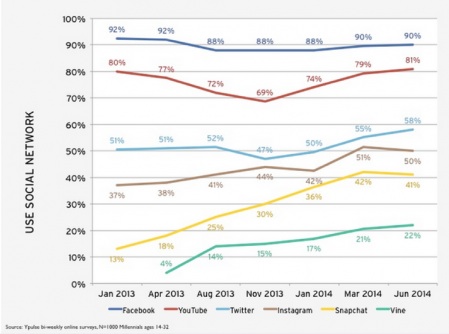
But I’m sure almost all millennials use social media in some way on some platform, and Ypulse tracks their use as it changes with a bi-weekly national survey of 1000 14-32 YOs -year-old Millennials nationwide” that helps it keep up with that rapid change. Here are some highlights, some of which are busting some myths that have developed:
- Facebook going strong. Reports of FB’s death among teen users are “greatly exaggerated,” as the popular misquote of Mark Twain goes. “We’ve seen the network dip slightly in popularity, but overall maintain its position as the No. 1 network that they say they use – by far,” Ypulse says. That’s all millennials. That just changed this year for the younger ones….
- YouTube No. 1 for 14-17 YOs. Ypulse says YouTube and Facebook just swapped positions this year, with 89% of this age group saying they use the former, “compared to 80% who say they use Facebook.”
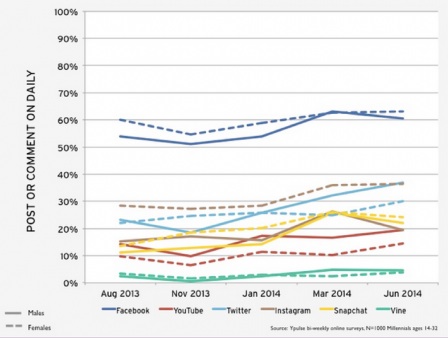
- BUT no. of accounts not everything. Having an account doesn’t necessarily spell active use, Ypulse points out. To measure level of activity in those accounts, it looks at daily use. Facebook reigns for all millennials, with “62% of 14-32 YOs using it daily” (Instagram and Twitter are “battling it out for second place”).
- Source of the mass-exodus-from-FB rumors: Where the rumors come from is the 14-17 YOs age group. Not their sheer numbers on Facebook but their daily use of it “has dropped significantly to 34%,” with Twitter and Snapchat having passed it up at 38% and 36%, respectively.
- Very, very visual. Fast and steady growth for Vine, Snapchat, and Instagram say so much (added to the YouTube picture). Among 14-17 YOs, Snapchat and Instagram are tied for 3rd place (61%, after YT and FB at 89% and 80%, respectively), Twitter in 4th at 58% and Vine coming up fast, now at 40% (compared to 4% a year ago last April!
- Greater individuality. Snapchat, Instagram and Vine are creative outlets for teens. They love expressing identity and individuality creatively as well as socially. These services provide “tools to make the visuals that they share into personalized mini works of art,” Ypulse reports. This reminds me of the old MySpace days (around 2006-’08), when teens would “pimp their profiles” by pasting 3rd-party code into them. It was more like social producing or creative networking than mere social networking. The difference now is a gazillion simple, single-purpose apps, with self-expression spread across a vast array of use cases.
- Smaller circles. “The other big draw” of these apps is that they allow sharing with “a more exclusive circle of followers,” Ypulse reports. “There is a real attraction to spaces that they feel only their peers are using” – or maybe close friends. The anonymity and ephemerality (like Snapchat’s disappearing snaps and vids) features lend themselves to more personal sharing.
- Big gender differences: Instagram is huge with young females, whose use has grown 10% this past year “and is far higher than male use.” For millennials overall, females’ use dominates in three of the services: Instagram, Facebook and Snapchat, in that order. Males’ use dominates on YouTube and, for now, Twitter. Vine is used pretty much equally by both.
The crucial characteristic not shown in this rolling survey of millennials’ social media use – or at least not in this report on it – is the growing diversification of sociality. What about Whisper, Yik Yak, Skout, WhatsApp, Kik, Twitch, social games on phones, social games online, social games on consoles, and on and on? Ask your 14-17 YOs’ what their Top 10 social media properties are, and put that in a comment. I bet you’ll see a lot of diversity even in your own house!
Related links
- “Social media ‘reality check’ from Canadian youth: Key study”
- “We ‘like’ faces in social media”
- Data on kids’ social media use from the SpeakUp Survey
- From 2013: “Teens on what’s trending in teen digital media use” and “Teens’ Top 5 social media picks: DIY survey”

[…] NetFamilyNews.org,. (2014). Millennials’ changing social media use: Survey – NetFamilyNews.org. Retrieved 22 November 2014, from http://nfn.wpengine.com/millennials-changing-social-media-use-ongoing-survey […]